

Emerging Salesforce Careers in the Metadata-Powered AI Era
Introduction: Salesforce Careers
The Salesforce ecosystem is evolving rapidly, driven by advancements in artificial intelligence (AI), automation, and metadata-driven development. With the introduction of Salesforce Einstein, Data Cloud, and an increasing reliance on metadata for customization, new career opportunities are emerging for professionals who can harness these technologies.
Table of Contents
1. The Role of Metadata in Salesforce AI
What is metadata in Salesforce?
Metadata is the backbone of Salesforce customization. It defines the structure and behavior of Salesforce applications without requiring code. Examples include:
- Objects & Fields (Custom objects, standard fields)
- Workflows & Processes (Flow, Process Builder)
- Security Settings (Profiles, Permission Sets)
- UI Configurations (Page Layouts, Lightning App Builder)
How AI Leverages Metadata
Salesforce Einstein AI uses metadata to:
- Automate predictions (e.g., lead scoring, opportunity insights).
- Personalize experiences (e.g., Einstein Recommendations)
- Enhance data management (e.g., Data Cloud segmentation)
With AI becoming more metadata-driven, professionals who understand both declarative automation and AI integration are in high demand.
2. Key Emerging Salesforce Careers
A. Salesforce AI Architect
Role: Designs AI-driven solutions using Einstein AI, Data Cloud, and metadata models.
Responsibilities:
- Architect AI-powered CRM solutions.
- Integrate Einstein predictions with business workflows.
- Optimize metadata for AI efficiency.
Why It’s Growing:
Companies need experts who can bridge the gap between AI models and Salesforce metadata.
B. Metadata-First Developer
Role: Builds applications using metadata tools (Flow, Lightning Web Components) instead of traditional Apex-heavy development.
Responsibilities:
- Develop low-code automation using Flow.
- Optimize performance of metadata configurations.
- Implement CI/CD for metadata deployments.
Why It’s Growing:
Salesforce is pushing “clicks-not-code,” making metadata developers crucial.
C. Data Cloud Specialist
Role: Manages Salesforce Genie (Data Cloud) to unify customer data for AI-driven insights.
Responsibilities:
- Design real-time data unification strategies.
- Configure identity resolution rules.
- Enable AI predictions using unified data.
Why It’s Growing:
Data Cloud is Salesforce’s future, and businesses need specialists to harness its power.
D. AI Ethics & Governance Consultant
Role: Ensures ethical AI use in Salesforce implementations.
Responsibilities:
- Audit AI models for bias.
- Implement governance frameworks.
- Ensure compliance with AI regulations.
Why It’s Growing:
As AI adoption increases, ethical concerns are rising, creating demand for governance experts.
E. Automation Engineer (Flow & Process Builder Expert)
Role: Specializes in no-code automation using Flow, Process Builder, and Einstein Next Best Action.
Responsibilities:
- Design complex business automations.
- Migrate from Workflow Rules to Flow.
- Optimize automation performance.
Why It’s Growing:
Salesforce is retiring Workflow Rules, making Flow experts indispensable.
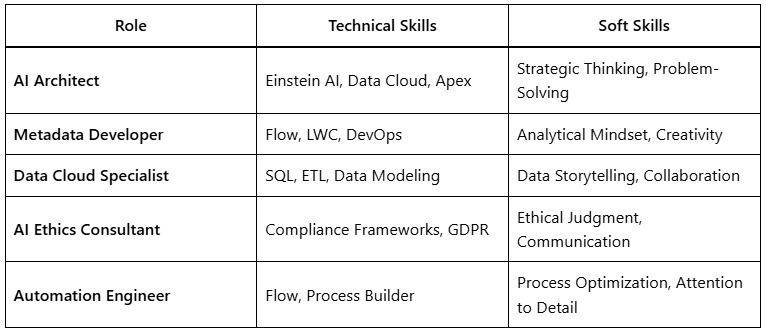
3. Skills Required for These Roles
4. How to Prepare for These Careers
Step 1: Get Certified
- AI Architect: Salesforce Certified AI Associate
- Metadata Developer: Platform App Builder
- Data Cloud Specialist: Data Cloud Consultant Certification
Step 2: Gain Hands-On Experience
- Build AI-driven apps using Einstein Prediction Builder.
- Practice Flow automations in a Developer Org.
- Experiment with Data Cloud in Trailhead.
Step 3: Stay Updated
- Follow Salesforce’s AI & Metadata Roadmap.
- Join communities like Salesforce Stack Exchange and Trailblazer Community.
5. The Future and Trends in Salesforce AI & Metadata
1. Hyper-Personalization with AI
Salesforce will use metadata to deliver real-time, hyper-personalized customer experiences.
2. No-Code AI Customization
Business users will customize AI models without coding, using metadata-driven tools.
3. Unified Metadata Governance
Companies will adopt metadata governance frameworks to manage AI ethics and compliance.
4. AI-Powered DevOps
Salesforce deployments will be optimized using AI-driven metadata analysis.
My Takeaway:
The Salesforce ecosystem is rapidly evolving in the metadata-powered AI era, creating exciting new career opportunities. Roles like AI Solution Architects, Metadata Specialists, and Predictive Analytics Engineers are in high demand as businesses leverage AI-driven insights from Salesforce platforms. Professionals with expertise in CRM analytics, automation, and ethical AI implementation will thrive in this dynamic landscape. By upskilling in AI, metadata management, and Salesforce’s Einstein AI tools, individuals can position themselves at the forefront of this transformation.