

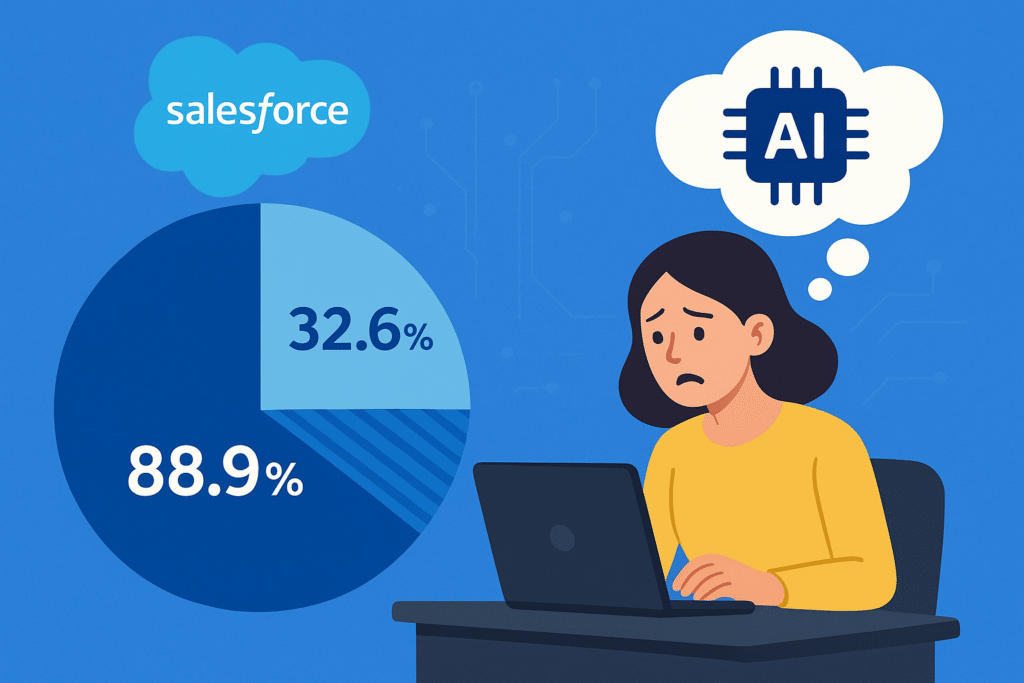
AI in Salesforce: 88.9% Adoption, 32.6% Struggle to Keep Up
Artificial Intelligence (AI) has moved from being a futuristic buzzword to a practical reality in modern business. Nowhere is this shift more visible than in the world of customer relationship management (CRM), where Salesforce leads the charge. Salesforce, known for revolutionizing the way companies manage sales and customer data, has fully embraced AI, integrating it into almost every aspect of its platform.
Recent statistics reveal an astonishing 88.9% of Salesforce users have already adopted some form of AI. At first glance, this number reflects extraordinary progress an overwhelming majority of businesses are leveraging AI to automate workflows, predict outcomes, and personalize customer interactions.
But there’s another side to the story: 32.6% of these same users admit they are struggling to keep up with the pace of change and the complexities that AI brings. This creates a unique landscape where AI is both a transformative opportunity and a source of organizational growing pains.
In this blog, we’ll explore the dynamics of this transformation—why AI adoption in Salesforce has skyrocketed, the benefits it delivers, the challenges users face, and how companies can bridge the gap between adoption and true mastery.
Table of Contents
The Evolution of AI in Salesforce
Why AI adoption in Salesforce is so high, we need to take a step back. When Salesforce first introduced Einstein AI in 2016, it was considered groundbreaking a way to embed intelligence into CRM workflows. At the time, AI was a buzzword, and few companies had the infrastructure to fully leverage it.
Customer expectations have changed dramatically. People now demand personalized experiences, rapid responses, and predictive recommendations. Businesses can no longer rely on static dashboards or manual data entry—they need real-time intelligence that only AI can provide.
Salesforce has positioned itself as the leader in this space by integrating AI into its core features: lead scoring, opportunity management, service automation, marketing personalization, and predictive analytics. The result is that nearly nine out of ten Salesforce users are already using AI in some form, whether they realize it or not.
Why Adoption Has Reached 88.9%
So, what’s driving such widespread adoption? Several factors stand out:
- Native AI Capabilities: With Einstein AI embedded into Salesforce, many features work out-of-the-box. Businesses don’t need separate AI platforms.
- Demand for Personalization: Customers expect brands to anticipate their needs. AI helps tailor messages, offers, and services at scale.
- Competitive Pressure: In saturated markets, companies that don’t leverage AI risk falling behind rivals who do.
- Automation Benefits: AI reduces repetitive tasks, freeing up employees to focus on higher-value work.
- Data Explosion: With businesses generating more data than ever before, manual analysis is no longer feasible. AI turns raw data into actionable insights.
These drivers make AI not just attractive but essential for Salesforce users.
Common AI Use Cases in Salesforce
The 88.9% adoption rate does not mean every business uses AI the same way. Instead, they adopt it in specific areas where it delivers the most value. The most popular applications include:
- Sales Forecasting: AI predicts the likelihood of deals closing and helps managers allocate resources strategically.
- Lead Scoring: Algorithms identify which leads are most likely to convert, enabling reps to focus their efforts.
- Service Chatbots: Einstein Bots automate responses to common questions, reducing wait times and improving customer experience.
- Churn Prediction: AI flags at-risk customers so businesses can intervene before losing them.
- Personalized Marketing: Campaigns become smarter, sending the right message to the right person at the right time.
- Workflow Automation: From case routing to report generation, AI eliminates tedious manual processes.
AI directly tackles real business challenges and drives measurable impact.
The 32.6% Struggle: Why Keeping Up Is Hard
Despite the impressive adoption numbers, nearly one-third of Salesforce users struggle to keep pace. This challenge is not about reluctance to use AI but about the practical difficulties of making it work effectively.
1. Data Quality Issues
AI’s accuracy depends on the data it consumes. Many organizations struggle with incomplete, inconsistent, or siloed data, which limits AI’s effectiveness.
2. Skills Gap
AI may be embedded in Salesforce, but using it to its full potential often requires technical knowledge. Many teams lack the expertise to configure and fine-tune AI features.
3. Complexity of Features
Einstein AI offers dozens of capabilities, from predictive scoring to natural language processing. For many businesses, it’s overwhelming to know where to start.
4. Rapid Evolution
AI in Salesforce is constantly evolving. Regular updates bring new tools, but keeping up requires ongoing investment in learning and adaptation.
5. Budget & Resource Constraints
Smaller businesses, in particular, find it difficult to allocate the resources financial and human—needed to maximize AI.
6. Cultural Resistance
Some employees distrust AI or are hesitant to rely on machine-driven insights. Change management becomes as important as technical enablement.
These challenges show that while turning AI on is easy, unlocking its full potential is much harder.
The Tangible Impact of AI in Salesforce
For those who succeed in implementation, the rewards are substantial. Surveys consistently report measurable gains:
- Sales productivity increases by 20–30%.
- Customer satisfaction improves by 25–35%.
- Operational costs decline by 10–20% due to automation.
Real-world examples illustrate this impact. A retail brand may use Salesforce AI to recommend products based on browsing history, boosting sales. A financial services firm might predict which clients are at risk of churn, enabling proactive outreach. In healthcare, AI helps personalize patient engagement and streamline care coordination.
Adoption Patterns Across Industries
Not every industry uses AI the same way. Adoption patterns reflect unique business challenges:
- Retail & eCommerce: Personalized product recommendations, dynamic pricing, and customer journey mapping.
- Financial Services: Risk scoring, fraud detection, and predictive investment insights.
- Healthcare: Predictive patient care, personalized treatments, and improved patient engagement.
- Manufacturing: Forecasting demand, predictive maintenance, and supply chain optimization.
- SaaS & Technology: Subscription churn prevention, automated onboarding, and AI-driven support.
The versatility of AI ensures its adoption across nearly all sectors.
Overcoming the Struggles: Best Practices
For the 32.6% of users struggling, success lies in approaching AI strategically. Here are proven best practices:
- Invest in Data Hygiene: Clean, consistent, and integrated data is the foundation for reliable AI.
- Start Small: Focus on one high-impact use case such as lead scoring before scaling further.
- Upskill Teams: Leverage Salesforce Trailhead, certifications, and workshops to build AI expertise.
- Use Partners & Consultants: Implementation experts can help configure advanced features and accelerate adoption.
- Adopt Change Management: Engage employees early, showcase success stories, and address skepticism.
- Measure ROI Continuously: Track outcomes like conversion rates, customer satisfaction, and efficiency gains.
These strategies turn adoption struggles into opportunities for long-term growth.
The Future of AI in Salesforce
Salesforce is doubling down on AI innovation. Generative AI, conversational intelligence, and hyper-personalization are set to redefine CRM.
- Generative AI: Automating personalized emails, proposals, and campaigns.
- Conversational AI: Natural language interfaces allowing users to “ask Salesforce” for insights.
- Real-Time Next-Best Actions: AI will not just predict outcomes but also recommend what to do next.
- AI-Powered Development: Low-code/no-code tools will make AI accessible to non-technical users.
- Integration with Emerging Tech: IoT, blockchain, and AR/VR will expand Salesforce AI use cases.
The pace of innovation suggests that the adoption vs. struggle gap may widen unless organizations prepare now.
Conclusion:
The story of AI in Salesforce is one of widespread adoption and persistent challenges. With 88.9% of users adopting AI, it’s clear that businesses recognize the value and necessity of intelligent CRM. But with 32.6% struggling to keep up, it’s equally clear that adoption does not equal mastery. The key takeaway is this: AI in Salesforce is not just a technology it’s a transformation. To succeed, businesses need more than features. They need strategy, culture change, and continuous investment in skills and data. Salesforce becomes more than a CRM. It evolves into a powerful engine for growth, customer engagement, and competitive differentiation.