


Exitforce Trend: Is It Time for Entry-Level Salesforce Pros to Pivot?

Introduction: Exitforce Trend
The Salesforce ecosystem has long been a lucrative career path for professionals seeking stability, high salaries, and remote work opportunities. However, as we move deeper into 2025, a concerning trend has emerged “Exitforce” a wave of entry-level Salesforce professionals leaving the ecosystem due to market saturation, AI-driven automation, and shifting industry demands.
Table of Contents
1. Understanding the Exitforce Trend
What is Exitforce?
Exitforce refers to the growing number of Salesforce administrators, developers, and consultants, particularly at the entry level, exiting the ecosystem due to
- Oversaturation of certified professionals
- AI-powered automation reducing demand for manual tasks
- Increased competition from offshore talent
- Economic pressures forcing companies to cut costs
Key Data Points (2025)
- Certification Growth: Over 2.5 million Salesforce professionals are now certified, a 300% increase since 2020.
- Job Postings Decline: Entry-level Salesforce job postings have dropped by 22% since 2023.
- Salary Stagnation: Median salaries for junior roles have plateaued, with some markets seeing 5-10% decreases due to outsourcing.
2. Why Are Entry-Level Professionals Struggling?
A. Market Saturation
Salesforce was once a “golden ticket” for career changers, but the influx of bootcamp graduates and self-taught professionals has led to fierce competition.
- Too Many Admins, Too Few Jobs: Companies now prefer experienced hires over entry-level admins.
- Certification Inflation: Holding a Salesforce Admin cert no longer guarantees job security.
B. AI & Automation Disruption
Salesforce Einstein AI and third-party automation tools (e.g., Copilot for CRM) now handle:
- Basic reporting & dashboards
- Lead scoring & routing
- Email automation & workflows
Result? Fewer manual tasks = reduced demand for junior roles.
C. Offshore Outsourcing Pressure
Companies are hiring remote teams in India, Latin America, and Eastern Europe at 30-50% lower salaries, squeezing U.S.-based entry-level professionals.
D. Economic Downturn & Hiring Freezes
Many tech firms have slowed Salesforce hiring due to:
- Recession fears
- Cost-cutting measures
- Shift to multi-cloud strategies (reducing pure Salesforce dependency)
3. Should Entry-Level Salesforce Pros Pivot?
Signs: It’s Time to Pivot.
✅ You’ve applied to 100+ jobs with no responses.
✅ Your salary hasn’t grown in 2+ years.
✅ You’re stuck doing low-value, repetitive tasks.
✅ AI tools (e.g., Einstein Copilot) are replacing your work.
Signs You Should Stay
✔ You’re specializing (e.g., CPQ, Industries, Revenue Cloud).
✔ You’re moving into consulting or architecture.
✔ Your company is investing in your upskilling.
4. Best Pivot Options for Salesforce Pros (2025)
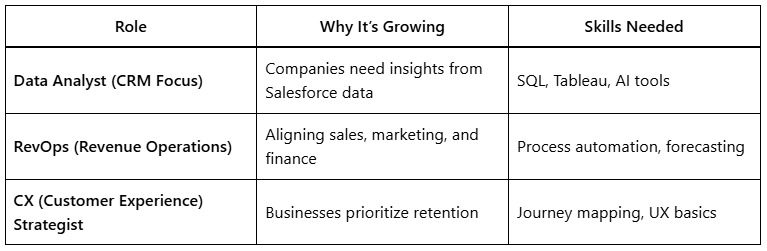
A. Move into Salesforce-Adjacent Roles
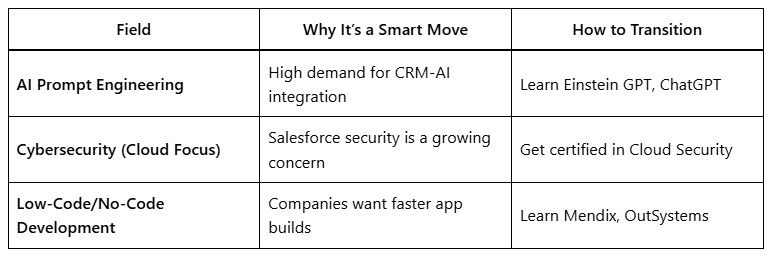
B. Transition into Emerging Tech Fields
C. Shift to Other CRM Platforms
- HubSpot (growing in the SMB market)
- Microsoft Dynamics 365 (enterprise demand rising)
- Oracle CX (niche but high-paying roles)
5. How to Future-Proof Your Salesforce Career
If you choose not to pivot, consider:
A. Specialize in High-Demand Areas
- Industries (e.g., Healthcare, Financial Services Cloud)
- CPQ & Billing
- Integration (MuleSoft, AWS)
B. Upskill in AI & Automation
- Salesforce Einstein AI certifications
- Prompt engineering for CRM workflows
C. Move into Leadership
- Salesforce Architect (higher barriers to entry)
- Consulting/Independent Contractor (more control over rates)
6. Final Verdict: To Pivot or Not?
Pivot If:
- You’re struggling to land interviews.
- You’re doing easily automated tasks.
- You want faster career growth.
Stay & Specialize If:
- You’re in a high-demand niche.
- Your employer is investing in your growth.
- You’re on a path to architecture or leadership.
My Takeaway:
The Exitforce trend signals a shifting landscape for entry-level Salesforce professionals. With automation, AI integration, and rising expectations for multi-skill roles, it’s no longer enough to rely solely on basic admin knowledge. Newcomers must pivot upskilling in areas like AI, data analytics, and automation tools to stay relevant. Embracing continuous learning, gaining certifications, and exploring niche Salesforce roles can help future-proof their careers.