

Salesforce in Japan: CRM Transformation Trends 2025-26
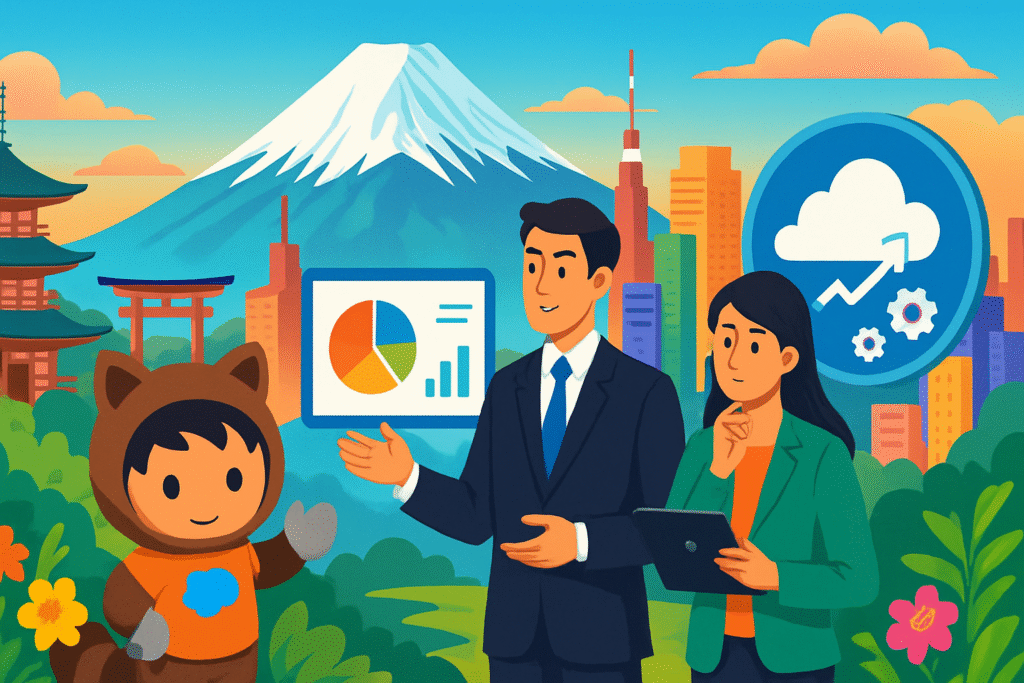
Introduction: Salesforce in Japan
Customer Relationship Management (CRM) has become a cornerstone of business success, and Salesforce continues to lead the charge in digital transformation. In Japan, where technological innovation meets traditional business practices, Salesforce adoption is accelerating, reshaping industries from finance to retail.
This blog explores the major CRM transformation trends in Japan, highlighting how companies are using Salesforce to stay competitive in an increasingly digital economy.
Table of Contents
1. AI and Automation Take Center Stage
Einstein AI Driving Hyper-Personalization
Salesforce Einstein AI is becoming indispensable for Japanese businesses. Companies are using AI-driven insights to:
- Predict customer behavior with greater accuracy.
- Automate routine tasks (e.g., lead scoring, email responses).
- Deliver hyper-personalized marketing campaigns.
Example: A major Japanese e-commerce platform uses Einstein AI to recommend products based on real-time browsing behavior, increasing conversion rates by 30%.
Process Automation with Salesforce Flow
Robotic Process Automation (RPA) and Salesforce Flow are reducing manual workloads. Key use cases include:
- Automated customer onboarding.
- AI-powered chatbots for 24/7 support.
- Dynamic case routing in service clouds.
Trend: By 2026, over 60% of Japanese enterprises will integrate AI-driven automation into their CRM workflows.
2. Industry-Specific Cloud Solutions Gain Traction
Financial Services: Salesforce Financial Services Cloud
Japanese banks and insurers are adopting Salesforce to:
- Offer personalized financial advice.
- Streamline client onboarding with digital KYC (Know Your Customer).
- Improve compliance with automated reporting.
Case Study: A leading Japanese bank reduced customer onboarding time by 50% using Salesforce Financial Services Cloud.
Healthcare: Health Cloud for Patient Engagement
With Japan’s aging population, healthcare providers are using Salesforce to:
- Manage patient records securely.
- Automate appointment scheduling.
- Provide telehealth integrations.
Prediction: By 2026, 40% of Japanese hospitals will use CRM platforms like Salesforce for patient management.
Manufacturing & Logistics: Field Service & IoT Integration
Salesforce Field Service Lightning is helping manufacturers:
- Optimize supply chains with real-time tracking.
- Improve equipment maintenance using IoT sensors.
- Enhance technician dispatch efficiency.
Trend: IoT-connected CRM systems will become standard in Japan’s manufacturing sector by 2026.
3. Hybrid and Remote Workforces Demand Digital Collaboration
Salesforce Slack Integration for Seamless Communication
With hybrid work becoming the norm, Japanese firms are adopting Slack-integrated Salesforce to:
- Cross-department collaboration.
- Automate alerts (e.g., deal closures, support tickets).
- Improve project management.
Example: A Tokyo-based tech firm reduced email reliance by 70% after integrating Slack with Salesforce.
Digital HQ: The Future of Work
Salesforce’s “Digital HQ” concept is gaining traction, allowing companies to:
- Centralize remote work tools.
- Track productivity with analytics.
- Maintain company culture through virtual spaces.
Forecast: By 2026, 80% of Japanese enterprises will adopt a Digital HQ strategy.
4. Sustainability and ESG Become CRM Priorities
Green CRM: Reducing Carbon Footprints
Japanese corporations are aligning CRM strategies with ESG (Environmental, Social, Governance) goals by:
- Using Salesforce Sustainability Cloud to track carbon emissions.
- Promoting eco-friendly products via targeted campaigns.
- Automating sustainability reporting.
Case Study: A major retail chain in Japan cut paper usage by 90% after digitizing customer records in Salesforce.
Social Impact Through CRM
Companies are leveraging Salesforce to:
- Track corporate social responsibility (CSR) initiatives.
- Engage customers in sustainability programs.
- Measure impact through data analytics.
Trend: ESG-focused CRM strategies will be mandatory for Japanese enterprises by 2026.
5. Hyper-Personalization Through Data Unification
CDP (Customer Data Platform) Adoption
Japanese businesses are unifying data sources using Salesforce CDP to:
- Create 360-degree customer profiles.
- Deliver real-time personalized experiences.
- Improve marketing ROI with precise segmentation.
Example: A luxury brand in Tokyo increased customer retention by 25% after implementing Salesforce CDP.
First-Party Data Strategies Replace Third-Party Cookies
With privacy regulations tightening, companies are:
- Building first-party data ecosystems.
- Using Salesforce to manage consent-based marketing.
- Leveraging zero-party data (customer-provided preferences).
Prediction: By 2026, 75% of Japanese marketers will rely on first-party data for personalization.
6. Blockchain and CRM Security Enhance Trust
Secure Customer Data with Blockchain
Salesforce is integrating blockchain for:
- Fraud-proof transaction records.
- Tamper-proof customer agreements.
- Transparent loyalty programs.
Trend: Financial and real estate sectors in Japan will lead blockchain-CRM adoption.
Compliance with Japanese Data Laws
Strict regulations (e.g., APPI amendments) require:
- GDPR-like data handling in Salesforce.
- Automated compliance reporting.
- Secure cloud storage solutions.
Forecast: Data sovereignty will drive local cloud adoption in Japan.
7. The Rise of Low-Code/No-Code CRM Customization
Empowering Business Users with Salesforce Lightning
Non-technical teams are building custom apps using:
- Salesforce AppExchange for pre-built solutions.
- Lightning Flow for workflow automation.
- Low-code tools for rapid CRM adjustments.
Example: A mid-sized retailer in Osaka developed a custom loyalty app in weeks using Salesforce low-code tools.
Faster Digital Transformation
Low-code adoption is accelerating CRM deployments by:
- Reducing IT dependency.
- Cutting development costs.
- Enabling agile updates.
Trend: By 2026, 50% of Japanese CRM customizations will be low-code-driven.
8. Omnichannel Experiences Become the Norm
Seamless Customer Journeys Across Channels
Japanese consumers expect consistency across:
- Social media (LINE, Twitter/X integration).
- E-commerce (Shopify-Salesforce connectors).
- In-store digital touchpoints.
Case Study: A cosmetics brand unified online-offline customer data, boosting sales by 35%.
Voice Commerce and AI Assistants
Salesforce is integrating with:
- Smart speakers (e.g., Amazon Alexa, Google Home).
- Voice-enabled customer service.
- AI-powered shopping assistants.
Prediction: Voice-driven CRM interactions will grow 200% by 2026 in Japan.
The Future of Salesforce in Japan (2025-26)
Japan’s CRM landscape is undergoing a massive shift, driven by AI, industry-specific clouds, and hyper-personalization. Key takeaways:
- AI & Automation will dominate CRM workflows.
- Industry Clouds will tailor solutions for finance, healthcare, and manufacturing.
- Hybrid Work will rely on Digital HQ strategies.
- Sustainability will be embedded in CRM practices.
- Data Privacy & Blockchain will enhance security.
- Low-Code CRM will democratize digital transformation.
- Omnichannel Experiences will define customer engagement.
Businesses that embrace these Salesforce trends will lead Japan next wave of CRM innovation.
Conclusion:
Salesforce continues to drive CRM innovation, helping businesses enhance customer engagement and operational efficiency. Key trends for 2025-26 include AI-powered automation, hyper-personalization, and seamless omnichannel experiences. Companies are leveraging Salesforce’s cloud solutions to integrate data analytics, IoT, and generative AI for smarter decision-making. With a strong focus on compliance and localization, Salesforce supports Japan unique business culture while enabling global scalability